Recycled & Upcycled Crafts
A Cable Organizer Made From Cardboard Tubes
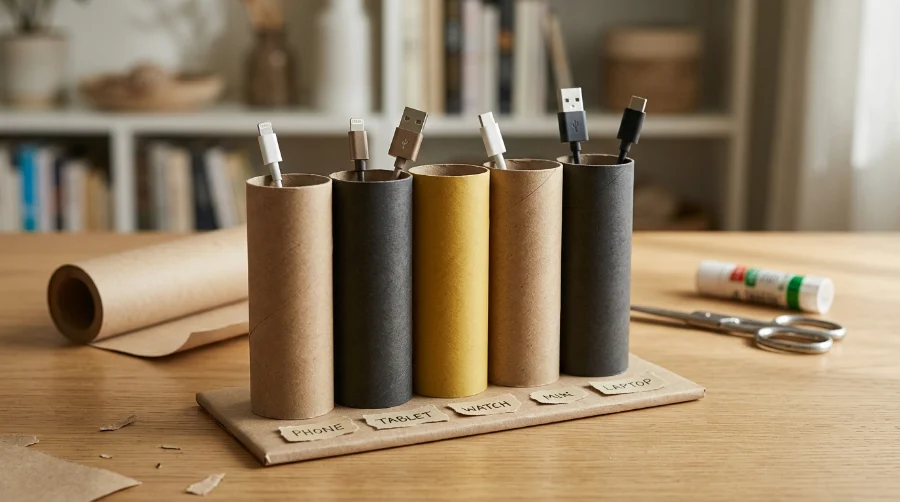
Charging cables tend to collect in a loose knot at the back of a desk, and the plug heads are usually what cause the tangle. A holder made from covered cardboard…
A glass jar makes a handsome herb planter because the roots and soil layers stay visible. That same transparency hides a practical problem: a jar filled with damp…
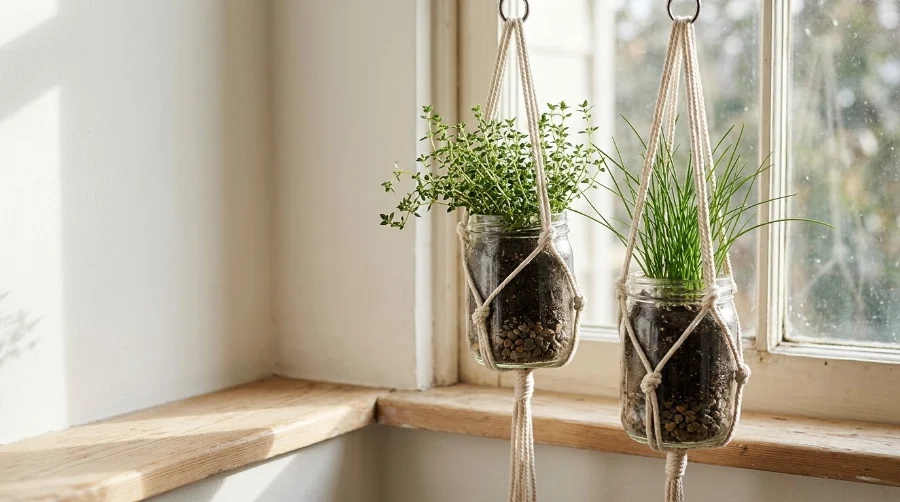
A glass jar makes a handsome herb planter because the roots and soil layers stay visible. That same transparency hides a practical problem: a jar filled with damp potting mix is far heavier than it looks, and the weight hangs from whatever cord or hook holds it. A hanging planter that fails dumps soil, water, and broken glass onto the floor. Treat the hanger and the mounting point as the most important parts of the project, and build the planting around them.
Used carefully, a jar can support a small herb for a long time. The essentials are a manageable size, a place for excess water to go, and a hanger matched to the weight rather than the look.
Small jars are the safe starting point. A jar in the 8 to 16 ounce (about 250 to 500 ml) range holds enough soil for a single herb and stays light enough for a modest hanger. Large pasta or gallon jars become surprisingly heavy once filled with wet mix, and the weight grows again after watering. Choose jars with straight or gently tapering sides; a narrow neck makes planting awkward, and a pronounced waist traps soil where a root ball cannot settle.
Check the rim and body for chips, hairline cracks, or rough spots. A flaw harmless on a shelf can split under the strain of a filled hanger. Discard any cracked jar.
Remove labels with warm, soapy water and a soak, then rub away remaining adhesive with a plastic scraper. Avoid steel wool on glass that will be left clear, since it can leave fine scratches. Wash the inside thoroughly and let it dry completely before adding soil; damp residue can encourage mold in a closed container.
Even a factory-smooth rim can feel sharp after a label has been scraped away. Run a fingertip around the lip and the base. If it catches, smooth the spot with fine abrasive paper or skip that jar. Keep broken glass out of the workspace and never hang a chipped jar.
Roots need oxygen as much as water, and a sealed jar offers neither drainage nor airflow. Without an exit, water collects at the bottom and sits against the roots, which leads to rot even when the top of the soil looks dry.
The simplest fix is a layer of coarse material at the base: small gravel, expanded clay pellets, or broken terracotta pieces. Roughly one inch (2.5 cm) is a useful starting depth, added after checking that the jar sits level. A thin charcoal layer above the gravel can help keep the enclosed environment fresh, though it is optional.
Water slowly and in small amounts. Pour along the inside wall rather than directly against the stem, and stop as soon as the soil is evenly damp. Tip the jar to pour off any excess that collects above the gravel; never leave standing water at the roots. A narrow-necked jar can hide a pool at the bottom, so a long-spouted watering can or a syringe gives better control.
Because the jar has few or no drainage holes, watering is less frequent than for a clay pot. Check the soil with a finger before adding more and let the top feel dry between waterings. If the jar has no drainage hole at all, treat the gravel layer as a reservoir and keep the total amount of water small.
Three hanger styles suit small jars. A wire basket holds the jar from below and tightens around its body with a ring or clasp; it distributes weight well and suits tapered jars. A rope sling uses two loops that cradle the jar and meet at a ring above. A three-cord hanger wraps the jar with evenly spaced cords that join at a top knot, which looks tidy and works best on a cylindrical shape.
Match the hardware to the load. A filled jar can weigh several times the empty jar, so use cord rated well above that weight and a hook screwed into a stud or ceiling joist rather than drywall alone. A decorative hook in plaster is not a structural fastener. If the mounting point is in doubt, move the planter to a stud or use a free-standing display instead.
No-drill options cover many situations. A tension rod in a window recess can carry a lightweight jar on a sliding hook, and a curtain rod held by its brackets works for a small cluster. Over-the-door hooks and rail-mounted plant hangers also avoid drilling. Each still needs a secure anchor; a rod that twists under load is not safe.
Drilling becomes necessary when hanging from a ceiling or a wall without an existing fixture. Locate a stud with a finder, drill a pilot hole, and screw in a rated eye screw or hook that pulls straight into the wood. Wear eye protection when drilling overhead and clear the area below before starting. If the ceiling surface is uncertain, ask someone experienced rather than trusting a guess.
Set the jar on a stable surface throughout. A filled jar is awkward to handle, and a slip now is more likely than once it is hanging.
Most culinary herbs want bright, indirect light for a good part of the day. A south-facing window in summer can cook a glass jar and its roots, so choose a spot with morning sun or filtered light through the middle of the day. A jar in hot sun can heat the soil quickly and stress the plant even when watering is careful. Turn the jar every week or so to keep growth even.
Small herbs suit small jars. Thyme, oregano, chives, and compact basil varieties adapt to a narrow root space. Parsley and cilantro can work in a slightly larger jar. Mint grows aggressively and is better kept in its own container, since it will fill a small jar quickly. Woody herbs such as rosemary and sage prefer more root room than a tiny jar provides, so give them a larger vessel or skip them.
Overwatering is the most common failure. Soil that stays soggy, a musty smell, or a plant that droops despite wet soil all point to too much water. Let the soil dry further, pour off any pooled water, and water less often afterward.
A weak hanger shows itself as a hook that pulls loose or cords that slip. Take the planter down, reduce the load if possible, and upgrade the hook or cord. A jar hung in a busy hallway is a hazard; keep it away from doorways, stairs, and places where people brush past.
No drainage means no safety valve. If water collects at the base after every watering, add a gravel layer or switch to a jar with an opening wide enough to spoon out the excess. A plant sitting in hot sun should move to a brighter but cooler spot before the roots suffer.
Variations keep the project flexible. Paint the outside of the jar with glass paint, etch a simple band, or wrap the middle with twine before hanging. A group of three small jars at different heights makes a window display, provided each has its own secure hook. A jar with a wider mouth can hold a small succulent mix, which needs even less water. Whatever the variation, recheck the hanger after watering, since the planter is heaviest then.
Projects that pair well with this one.
Charging cables tend to collect in a loose knot at the back of a desk, and the plug heads are usually what cause the tangle. A holder made from covered cardboard…
A pocket glued to a flat panel sags for one mechanical reason: the bond holds the back of the pocket to the backing, but everything dropped inside pulls on the…
Be clear about the limit before the build starts: cork tolerates warmth, not direct high heat. A trivet made this way protects a serving dish that has come off the…